
Combined Versus Singular Therapy of Coconut (Cocos nucifera L.) Water and Lime (Citrus aurantiifolia L) Juice in Diabetes Control: Impacts, Implications, and Therapeutic Differences
Abstract
This study determined and compared the effects of single and combined therapy of coconut water and lime juice in diabetes control in male diabetic Wistar rats.
Twenty eight male Wistar rats (weighing: 150-200g) were induced with diabetes mellitus using alloxan monohydrate solution (150mg/kg) and categorized into four experimental groups (n = 7, each): Diabetic Control (CTR), Diabetic treated with coconut water (CNW), Diabetic treated with coconut water and lime (BLC), Diabetic treated with lime (LMJ). Animals were fed according to the experimental design with water ad libitum for six (6) weeks. Body weights, blood glucose concentrations, glycemic tolerance and lipid profiles were measured and determined during the study. Data was analyzed using Microsoft Excels and Statistical SPSS program version 24. Results are expressed as mean ± SEM. Comparison between groups was made using Students’ t-test and one way ANOVA followed by Multiple Duncan tests. P value < 0.05 was set as significant.
Lime juice (πb.wt.- 5.60%, P = 0.003), coconut water (πb.wt.- 30.760%, P = 0.012) and Coco-lime mixture (πb.wt.- 11.10%, P = 0.028) decreased mean body weight gain (πb.wt.) significantly (P < 0.05) compared with the control (πb.wt. - 38.83%). Blood sugar level differentially decreased significantly in all treated groups: CNW (27.03%) > LMJ (19.5%) >> BLC (9.83%). Glycemic tolerance and lipid profile improved significantly with single administration better than combined administration.
In conclusion, single administration of coconut water and lime juice differentially improved diabetes control effectively in diabetic rats better than their combined mixture.
Article Information
- Received
- Accepted
- Published
Academic Editor: Ian James Martins, Principal Research Fellow, Edith Cowan University.
Checked for plagiarism: Yes
Review by: Single-blind
Copyright © 2025 Magnus Michael Chukwudike Anyakudo, et al.
 This is an open-access article distributed under the terms of the Creative Commons Attribution License, which permits unrestricted use, distribution, and reproduction in any medium, provided the original author and source are credited.
Corresponding author: Magnus Michael Chukwudike Anyakudo, Endometabolic and Nutrition Research Unit, Department of Human Physiology, Faculty of Basic Medical Sciences, College of Health Sciences, Federal University Lokoja, P.M.B 1154, Lokoja, Kogi State, Nigeria —
Competing Interests
The author declares that there is no conflict of interest.
Funding
This research received no external funding.
Data Availability
No data-availability statement was provided by the authors.
Acknowledgements
No acknowledgement.
Citation:
Introduction
Coconut water is a natural, nutritious, healthy and sterile fluid obtained from the endosperm cavity of the coconut fruit. It can be drunk fresh, used in cooking or fermented to produce coconut vinegar. It also contains several biologically active components including free amino acid L-arginine, ascorbic acid, minerals (calcium, magnesium, potassium, manganese, copper, iron, phosphorus, selenium), enzymes and growth hormones 1 which contribute to its nutritional benefits 2 and therapeutic effects such as cardioprotective, hepatoprotective, hypolipidemic and antihypertensive properties in experimental animals 3, 4, 5. Lime juice is a liquid expressed from lime fruit mesocarp pulp which has multiple phytochemical components such as polyphenols and terpenes 6 , many of which are under basic research for their potential properties in humans 7, 8. Lime juice can be taken fresh, added to honey and other fruit juice as a flavour; it serves several health benefits as reported by many studies.
In recent times, several approaches have been employed to tackle problems associated with uncontrolled diabetes and its associated complications. While focus in the pharmaceutical industry is directed towards producing drugs with optimal hypoglycemic and minimal adverse effects, numerous studies have been geared towards exploring the potentiality of alternative remedies of natural products which are competitively effective, affordable, accessible and available for diabetes control 9, 10, 11.
Health benefits of coconut water and lime juice have been reported by many studies. However, in our study, we examined and compared the effects of singular and combined administration of coconut water and lime juice portions on weight management, glycaemic and lipid control in diabetic Wistar rats with the rationale to evaluate their efficacy and determine the most suitable way of administration of such natural fruit extracts for optimal, desirable, and therapeutic benefits in diabetes control.
Attention to alternative or complementary medicine in the management of medical disorders using combined phytotherapy is on the increase in recent times without adequate precautions taken to critically examine and evaluate the consequence of such combination therapy on their efficacy and overall health effects. Therefore, to abate unexpected health consequences due to such negligence, it’s pertinent that prior to recommendation of any product for consumption or application, necessary precaution and evaluation should be conducted as demonstrated in this study.
Materials and Methods
Plant Materials
The coconut (Cocos nucifera) and Lime (Citrus aurantiifolia) fruits were purchased from the local market in Ondo State of Western Nigeria with the help of an agriculturist who identified and authenticated the species purchased.
Preparation of Extracts
The coconut ectocarp and mesocarp were peeled to expose the hard endocarp seed. Through the germ pores, a drill was made to extract the coconut water from the endosperm cavity which was poured into a clean sterilized container and kept in the refrigerator at 40C. Lime juice was extracted from the mesocarp pulp of the lime fruit using a sieve and an extractor and subsequently kept in a different container in the refrigerator. Equal portions (250 mls) of coconut water and lime juice were mixed together to constitute the Coco-lime mixture (CLM). Fresh extracts were prepared each week.
Toxicity test
A modified stair-case method 12 was used to conduct the acute toxicity test for the extracts. Animals were provided orally with increasing doses of 5, 10, 15, 20 and 25mls of the extracts per kilogram body weight of the animal while the toxicity was assessed by mortality and behavioral changes of the rats. No toxic effect was observed in the range of doses applied.
Experimental Animals and Diets
The healthy animals were purchased from disease-free stock of Ade farm, Ogbomoso, Oyo state, Nigeria. Twenty-eight (28) male albino Wistar rats (Rattus norvegicus) weighing 150-200g were used for this investigation. The animals were kept in polypropylene cages with stainless wire mesh tops in a well-ventilated animal house for two weeks to allow them to acclimate to the environment at normal and standard laboratory temperatures and relative humidity. They were fed commercially available standard rat feed and water ad libitum for the two weeks. Under each cage, replaceable numbered blotter papers were placed to catch the spilled diet, which was measured to make up for the daily serving ration. The rats were weighed twice a week to ensure that none of them weighed outside the range.
Induction of Diabetes
After a 15-hour overnight fast following the period of acclimatization, twenty eight rats were injected by a single intraperitoneal injection of 150 mg/kg body weight of freshly prepared 2% Alloxan monohydrate (Sigma chemicals, USA) dissolved in sterile 0.9% normal saline in a standard volumetric flask strapped with foil to prevent alloxan instability. Diabetes was confirmed 4 - 7 days later by use of a glucometer (Fine Test Blood Glucose Monitoring System, Osang Healthcare, Codix Pharma, Doosan CO. Ltd. S. Korea) and compatible strips. Rats with Fasting Blood Glucose (FBG) level > 150 mg/dl were considered diabetic and used for this study. Diabetes was allowed to stabilize for 5 days before exposure to extracts.
Ethical Approval
The protocol of the experiment and the animal handling were carried out in strict compliance with the ethics and guidelines for animal care and use in research proffered by the Institution Review Committee and also in accordance with the guidelines provided by the Medical Association Declaration of Helsinki on ethical principles for Medical Research involving experimental animals 13.
Experimental Design
The diabetic animals were randomly grouped into four groups (n=7, each) as follows: Group CTR: Diabetic control treated with normal diet; Group CNW: Diabetic treated with coconut water; Group BLC: Diabetic treated with mixture of coconut water and lime juice and Group LMJ: Diabetic treated with lime juice. Rats in all groups were fed with standard rat feed throughout the period of the study. The administered dosage for the extracts was 25mls/kg b.w. The rats were monitored twice daily for food and water intake while body weight and FBS were assessed bi-weekly and recorded.
Blood Collection and Biological Assay
The blood samples were collected from the tail veins by phlebotomy (for OGTT) and by transdermal digital palpation-guided cardiac puncture technique (for lipid profile). The blood samples from the tail veins were applied directly to the glucometer strips to determine the blood glucose concentration while blood samples for lipid profile were stored in K3 EDTA bottles.
Oral Glucose Tolerance Test (OGTT) Determination
After 15 hours overnight fast with free access to water, FBS concentrations were determined followed by oral D-glucose load (2gm kg-ˡ dissolved in distilled water) administration to all the animals via flexible metal cannula. Blood samples were thereafter withdrawn from the tail vein of each animal at intervals of 30 minutes for 2 hours to determine the blood sugar concentrations (used for the construction of the glycaemic profile) using Fine Test Glucometer.
Lipid Profile Analysis
The standard lipid profile was conducted at the beginning and at the end of the study using the Standard Lipidocare Analyzer - SD Biosensor and Test Strips (Mark Enterprises, India). Sera obtained from the revolutionized blood samples were kept in K3 EDTA bottles and were used for lipid profile assay.
Statistical Analysis
The findings from each study group were compared using a one-way analysis of variance. Statistical method and program of Microsoft Excel and SPSS version 24 were used to analyse data. The mean and standard error of the mean were used to express the results while statistical significance was set at P < 0.05.
Results
Effects on Body Weight and Weight Gain
The initial and final mean body weights (πb.wt.) for each animal category are shown in Table 1. Lime juice, Coconut water and Coco-lime mixture significantly decreased πb.wt.gain in the following descending order: LMJ (πb.wt. - 5.60%, P = 0.003); BLC (πb.wt. - 11.10%, P = 0.028); CNW (πb.wt. - 30.760%, P = 0.012). This result implied that the weight-lowering effect of coconut water can be improved by adding lime juice to it. Conversely, excessive weight-lowering effect of lime juice can be reduced by adding coconut water to it. The proportion of mixture (mix ratio) is consequent upon the expected desired outcome of weight reduction and body fitness.
Table 1. Effect of Coconut Water, Lime Juice and their Mixture on Body Weight and Weight Gain (n = 5/group)| Parameters | Experimental Diabetic Animal Categories | |||
|---|---|---|---|---|
| Control CTR | Coconut Water CNW | Mixture BLC | Lime Juice LMJ | |
| Final Mean Weight (g) | 222.4 ± 24.6 | 206.6 ± 4.93 | 178.2 ± 9.64 | 169.6 ± 2.42 |
| Initial Mean Weight (g) | 160.2 ± 19.33 | 158.0 ± 3.37 | 160.4 ± 3.69 | 160.6 ± 6.46 |
| % Mean Weight Gain | 38.83% | 30.76%* | 11.10%** | 5.60%*** |
Effects on Glycemic Status
The comparative effects of lime juice, coconut water and their mixture on glycemic status in diabetic rats are depicted in Table 2. Differential hypoglycaemic effects were displayed by these natural products. The hypoglycaemic potential decreased in the order of coconut water, lime juice and coco-lime mixture. At the end of the sixth week, the percentage decrease in the mean FBS concentrations for the groups is as follows: CNW (27.03%); LMJ (19.5%); BLC (9.83%). The comparative difference in their hypoglycaemic effects was significant (P < 0.05).
Table 2. Effect of Coconut Water, Lime Juice and their Mixture on Venous Mean FBS Concentrations (mg/dL) (n = 5/group)| Parameters | Experimental Diabetic Animal Groups | |||
|---|---|---|---|---|
| Control CTR | Coconut Water CNW | Mixture BLC | Lime Juice LMJ | |
| Final Mean FBS (mg/dL) | 188.4 ± 9.62 | 165.8 ± 18.72 | 266.0 ± 35.25 | 204.0 ± 45.88 |
| Initial Mean FBS (mg/dL) | 184.8 ± 39.22 | 227.2 ± 44.84 | 295.0 ± 64.42 | 253.4 ± 70.64 |
| % Change in Mean FBS | 1.95% | -27.03% | -9.83% | -19.5% |
This study revealed that lime juice and coconut water have differential hypoglycemic impacts in diabetic rats with coconut water displaying more hypoglycemic effect than lime juice (P < 0.05). It also indicated that mixing of coconut water with lime juice does not enhance the hypoglycemic effect. Therefore, to achieve a good hypoglycemic effect, it is advisable that each product be taken separately.
Effects on Glycemic Tolerance and Profile
The glycemic tolerance was assessed by the incremental areas under the glycemic response curves as depicted in Figure 1. Both coconut water and lime juice potentiate good glycemic tolerance; however, glycemic tolerance improved better in CNW group than LMJ group. No significant change was observed in the glycemic response in BLC group served with the mixture of both coconut water and lime juice. The glycemic response to glucose load in all experimental groups peaked at 30 minutes of the 2 hour-duration.
Figure 1. Effect of coconut water, lime juice and their mixture on glycemic tolerance profile (n = 5/group). Animal groups: CTR – Control, CNW – Coconut water, LMJ – lime juice, BLC – Mixture 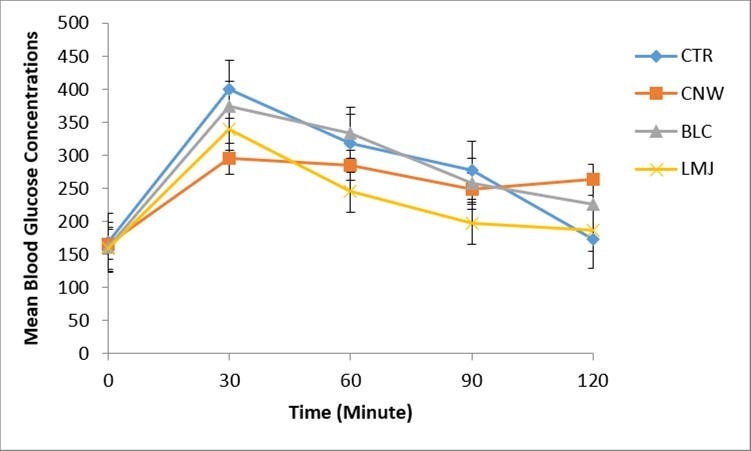
Download figure
Effects on Lipid Profile
The effect of coconut water, lime juice and their mixture on the lipid profile in diabetic rats is depicted in Figure 2. This study revealed that both coconut water and lime juice have differential antilipaemic potentials. However, lime juice has better antilipidaemic impact than coconut water. The mixture of coconut water and lime juice enhanced significantly (P < 0.05) the antilipidaemic activity in diabetic rats. At the end of the sixth week, lime juice, coconut water and the mixture of both caused a significant (P < 0.05) decrease in TC, TG and LDL concentrations with a corresponding increase (P < 0.05) in HDL concentration as compared with the control.
Figure 2. Effect of coconut water, lime juice and their mixture on lipid profile in experimental diabetic rats (n = 5/group). CTR – Control; CNW – Coconut water; LMJ – lime juice; BLC – Mixture of Co + Lm. TC: Total cholesterol; TG: Triglycerides; VLDL: Very Low-Density Lipoprotein; HDL: High Density Lipoprotein; LDL: Low Density Lipoprotein Cholesterol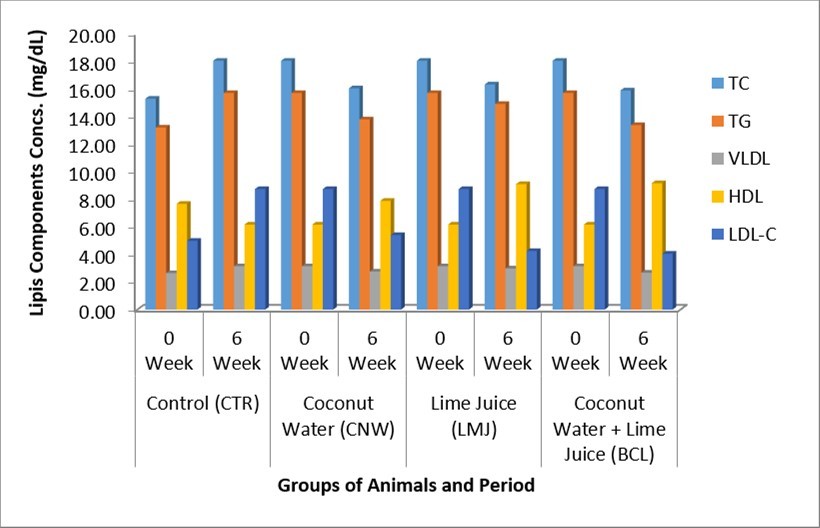
Download figure
Discussion
This study investigated and compared the singular and combined effects of coconut water and lime juice on body weight, lipid profile, glycaemic status and tolerance in diabetic Wistar rats. Findings obtained revealed that coconut water, lime juice and Coco-lime mixture differentially affect mean body weight gain, blood glucose concentrations, glycemic tolerance and lipid profile. Lime juice has more weight lowering effect than coconut water while coconut water has more hypoglycemic effects than lime juice. Mixture of lime juice and coconut water improved lipid profile mostly with intermediate weight-lowering effect and least hypoglycemic effect.
Nutrition scientists revealed that a direct correlation exists between plasma level of vitamin C and fat metabolism or oxidation leading to weight loss in obese and overweight individuals 14. The richness of Coconut water and citrus fruits in ascorbic acid and other micronutrients may explain the observed weight-lowering effects of these natural products in this study. While a study 15 revealed that individuals consuming sufficient amounts of vitamin C in their diet oxidized fat by about 30% during moderate exercise compared with individuals who have inadequate proportions of vitamin C, another study 16, reported an inverse relationship between body mass index/weight circumference and vitamin C level in non-smoking adults. Energy expenditure and satiety promotion have also been documented to be aided by regular ingestion of diets rich in micronutrients and vitamin C 17, 18. From the findings of this study, it can be deduced that the weight lowering effect of coconut water can be improved by adding lime juice to it while excessive weight lowering effect of lime can be reduced by adding coconut water: phytochemicals concentrations dilution.
The comparative hypoglycemic effects of lime juice, coconut water and their mixture on glycemic status in diabetic rats are depicted in Table 2. This study revealed that lime juice and coconut water have differential hypoglycemic impacts in diabetic rats with coconut water displaying more hypoglycemic effect than lime juice (P < 0.05). The hypoglycaemic potential decreased in the order of coconut water (27.03%), lime juice (19.5%) and mixture of lime and coconut water (9.83%) respectively. This implies that mixing of coconut water with lime juice does not enhance the hypoglycemic effect. Therefore, to achieve good glycemic control, it is advisable that each product be taken separately (singular therapy). Recent animal experiments have reported that coconut water can reduce blood glucose levels, regulate carbohydrate metabolism, and improve antioxidant capacity 19, 20 while a few studies reported the antidiabetic effect of Lime juice in experimental diabetic rats 21.
The antidiabetic properties of coconut water, lime juice and mixture of both were further expressed on glucose tolerance and profile as shown by the glycemic response curves in Figure 1. Both coconut water and lime juice showed good glycemic tolerance. However, glycemic tolerance improved better with coconut water than lime juice. The mixture of coconut water and lime juice displayed no significant improvement on glycemic profile. The glycemic response to glucose load in all the experimental groups peaked at 30 minutes of the 2 hour-duration, which suggests that the blood sugar lowering effect of coconut water, lime juice and the mixture of both can become manifest half an hour postprandially. Coconut water has been reported by some studies 22, 23, 24 to contain several biologically active components including free amino acid L-arginine, ascorbic acid, minerals such as calcium, magnesium and potassium, manganese, copper, iron, phosphorus, selenium, enzymes and growth hormones which contribute to its therapeutic effects and benefits such as cardioprotective, hepatoprotective, hypolipidemic and antihypertensive properties in experimental animals.
Effects of coconut water, lime juice and mixture of both on lipid profile in this study are demonstrated in Figure 2, it revealed that coconut water, lime juice and mixture of both significantly caused a decrease in TC, TG and LDL-C concentrations with a corresponding increase in HDL concentration as compared with the control. However, lime juice has better antilipidaemic impact than coconut water. The mixture of coconut water and lime juice enhanced the antilipidaemic activity significantly in diabetic rats. As a result, the study suggests that optimal eulipidemic control can be achieved by mixing a proportional amount of coconut water and lime juice together. The singular effects of coconut water and lime juice in this study agreed with findings of other studies 24, 25 which investigated singular administrative effects of tender coconut water on lipid profile. One of the studies revealed that a dose of 4 ml/ 100 g body weight of coconut water administered for 3 weeks reduced levels of LDL, TGA and increased HDL levels in mice fed a high-fructose diet 24, 25. Past and recent studies, however, demonstrated that flavonoids such as hesperidin and naringin present in citrus fruits (lime juice) are beneficial for improving hyperlipidemia and hyperglycemia in type-2 diabetic animals by partly regulating the fatty acid and cholesterol metabolism and affecting the gene expression of glucose-regulating enzymes 26, 27.
Conclusion
The singular and combined effects of coconut water and lime juice were investigated in diabetes control. Coconut water, lime juice and coco-lime mixture differentially affected mean body weight gain, blood glucose concentrations, glycemic tolerance and lipid profile. Lime juice has more weight lowering effect than coconut water while coconut water has more hypoglycemic effects than lime juice. Combined lime juice and coconut water mixture improved lipid profile mostly with associated intermediate weight-lowering effect and least hypoglycemic effect. These differential therapeutic impacts essentially suggest that the mode of administration of these two natural products influenced the therapeutic value and the expected outcome in diabetes control. For optimal and effective diabetes control, singular administration of each product is better compared with the mixture administration.
References
- 2.Reddy P, Lakshmi M. (2003) Coconut water properties, uses, and nutritional benefits in health and disease review. Journal of Current Clinical Medicine and Laboratory Biochemistry 10(2), 11-21.
- 3.Bhagya D, Prema L, Rajamohan T. (2012) Therapeutic effects of tender coconut water on oxidative stress in fructose fed Insulin Resistant Hypertensive Rats. Asian Pasific. 4, 270-6.
- 4.Sandhya, Rajamohan T. (2014) The role of coconut water on nicotine-induced reproductive dysfunction in experimental male rat model. Food Nutri Sci.,5:. 1121-1130.
- 6.Loizzo M R, Tundis R, Bonesi M, Menichini F, D et al. (2012) Evaluation of Citrus aurantifolia peel and leaves extracts for their chemical composition, antioxidant and anti-cholinesterase activities. J Sci Food Agric 92(15), 2960-67.
- 7.Nurang N, Wannee J. (2014) Anticancer activity of key lime, citrus aurantifolia. Pharmacognosy reviews 54(9), 24-25.
- 8.Patil J R, Chidambara Murthy KN, Jayaprakasha G K, Chetti M B, Patil B S. (2009) Bioactive compounds from Mexican lime (Citrus aurantifolia) juice induce apoptosis in human pancreatic cells. J Agric Food Chem 57(22), 10933-42.
- 9.Anyakudo MMC, Erinfolami A B. (2015) Glycemic and Wound Healing Effects of Aqueous Mesocarp Extract of Unripe Carica papaya (Linn) in Diabetic and Healthy Rats. World Journal of Nutrition and Health 3(3), 47-52.
- 10.MMC Anyakudo, Omogbehin N T, Adeyomoye O I. (2022) Beneficial Impacts of Solanum aethiopicum L. in Diabetes Control. International Journal of Nutrition 7(1), 30-40.
- 11.MMC Anyakudo, Bamidele O M. (2019) Dose-dependent Antidiabetic and Antiobesity Potentials of Aqueous Extract of Zingiber officinale Linn (Ginger) Rhizomes in Experimental Diabetic Rats: Need for Precaution? EC Nutrition 14.5. 468-473.
- 12.Chinedu E, Arome D, Ameh F S. (2013) A new method for determining acute toxicity in animal models. Toxicol Int 20(3), 224-6.
- 13. (2011) . Committee for the Update of the Guide for the Care and Use of Laboratory Animals. Guide for the Care and Use of Laboratory Animals. 8th ed National Research Council (US) , Washington, DC: National Academies Press; .
- 14.Julia K B, JMF Edith, Alida M B. (2024) A systematized review of the relationship between obesity and vitamin C requirement. Current Developments in Nutrition.8(5):. 102152.
- 15.Johnston C S. (2005) Strategies for healthy weight loss from vitamin C to the glycemic response. J. American College of Nutrition 24(3), 158-165.
- 16.Johnston S C, Beezhold L B, Mostow B, Swan D P. (2007) Plasma vitamin C inversely related to Body Mass Index and weight circumference but not to plasma adiponectin in non-smoking Adult. The Journal of Nutrition, 137 7, 1757-1762.
- 17.Yin j, Du L, Sheng C. (2022) Vitamin C status in relationship to glucose – lipid metabolism in overweight and obese patients following laparoscopic sleeve gastrectomy. European Journal of Clinical Nutrition 76, 1387-1392.
- 18.Lin S P, Fang H Y, Li M C. (2023) Relationship between overweight and obesity and insufficient micronutrient intake: a nationwide study in Taiwan. Journal of Nutritional Science, 12: 48.
- 19.Preetha P P, Devi V G, Rajamohan T. (2012) Hypolycemic and antioxidant effects of coconut water in experimental diabetes. Food Funct 3(7), 753-757.
- 20.Pinto I F, Siva R P, FAB Chaves, Dantas L S, Bispo V S. (2015) Study of antiglycation, hypoglycemic and nephroprotective activities of the green dwarf coconut water (Cocos nucifera L.) in nlloxan-induced diabetic rats. J. Med. Food 18(7), 802-809.
- 21.Duvbiama D, Adejumo I A, Ishola I, Akinleye M. (2023) The antidiabetic effect of the lime juice (Citrus aurantifolia) extract of Ficus exasperate in streptozotocin-induced rats. The Nigerian Journal of Pharmacy 57(2), 602-612.
- 22.Bhagya D, Prema L, Rajamohan T. (2012) Therapeutic effects of tender coconut water on oxidative stress in fructose fed insulin resistant hypertensive rats. Asian Pacific. 4, 270-276.
- 23.Sandhya, Rajamohan T. (2014) The role of coconut water on nicotine-induced reproductive dysfunction in experimental male rat model. Food Nutri Sci.,5:. 1121-1130.
- 24.Sandhya V G, Rajamohan T. (2008) Comparative evaluation of the hypolipidemic effects of coconut water and lovastatin in rats fed fat–cholesterol enriched diet. Food Chemical Toxicol 46, 3586-92.
- 25.Idoko A, VPO Ikpe, Nelson A. (2017) Effects of lime juice and honey on lipid profile of cholesterol enriched diet fed rat model. Anual Research and Review in. Biology 20(3), 1-10.